What Is Instant Dry Rice?
Instant dry rice is fully cooked, then dried to create a shelf-stable product that rehydrates in minutes. Raw rice needs 15-20 minutes of cooking; instant dry rice is ready in 5-6 minutes pour-over (basmati); 3-5 minutes in the microwave.
"Instant dry rice" is the specific format we make. It is one of four ways quick-prep rice reaches the plate, alongside retort rice (cooked and sealed wet in a pouch), freeze-dried rice (cooked then freeze-dried, usually imported), and frozen rice (cooked then frozen and kept in a cold chain). The four formats look similar on the shelf but differ in cost, weight, packaging, and logistics. See the comparison further down.
The instant rice category has existed for decades. In India, much of the supply has been imported freeze-dried rice. Zippy makes instant dry rice in India with a multi-stage cook and dry process.
Why Instant Dry Rice Is Growing
- Convenience: QSR chains, airlines, railways, and institutional kitchens need rice that is quick to prepare.
- Consistency: Consistent servings, batch to batch. Useful for multi-outlet chains.
- No cold chain: Ambient shelf-stable. Store and ship like any dry goods.
- Labour savings: HoReCa kitchens skip the rice-cooking step. Just add hot water.
- Light to ship: ~70g dry per serving. Retort and frozen rice carry their water, at ~225g per serving.
- Export: Made in India and shipped at ambient temperature.
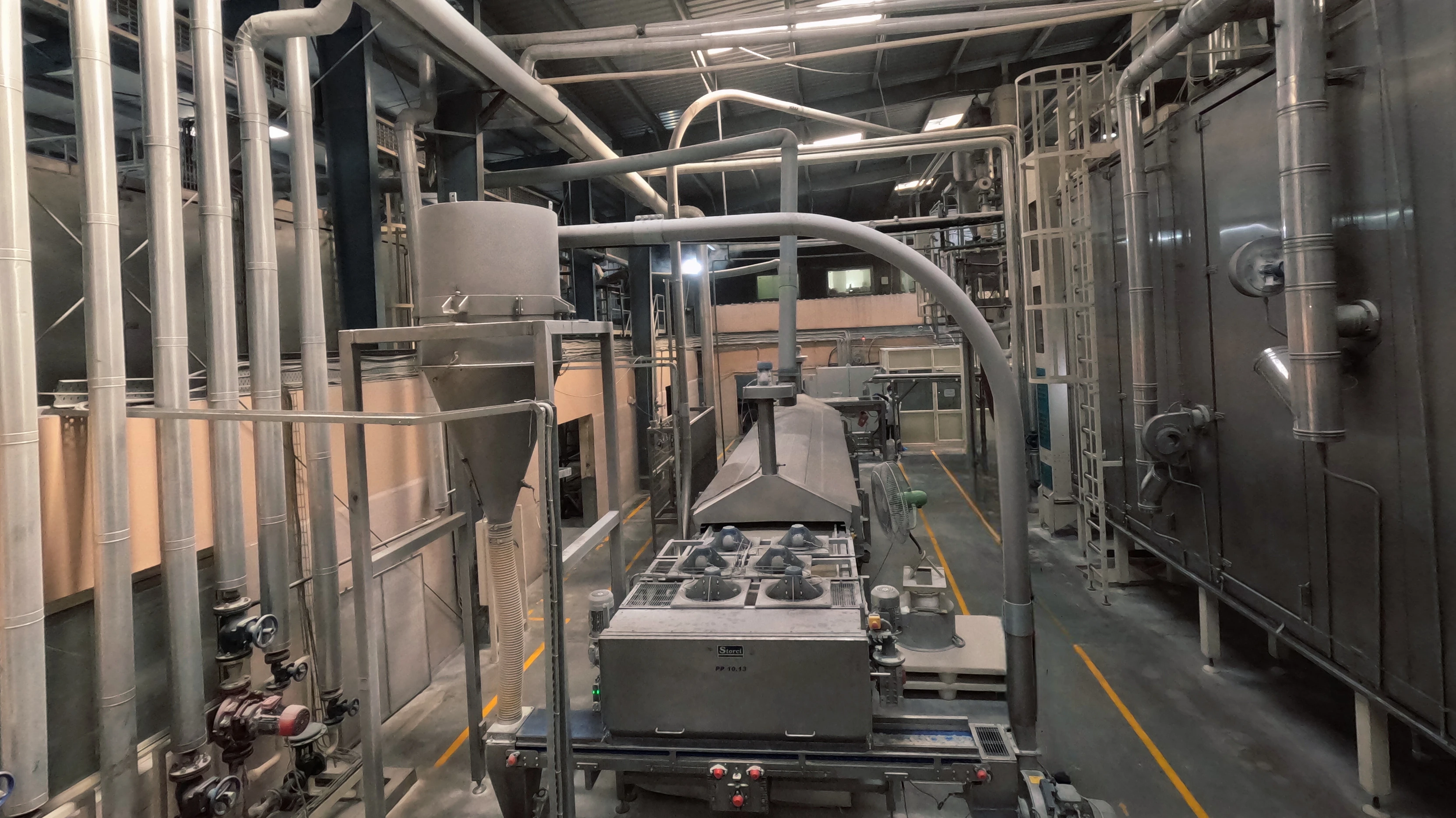
How Instant Dry Rice Is Manufactured
The production process involves multiple stages designed to fully cook the rice and then create a porous structure that allows rapid rehydration:
- Rice selection & soaking: Premium rice varieties are soaked to optimal moisture content. The choice of variety affects final texture and rehydration behavior.
- Multi-stage steaming: Controlled steaming fully gelatinizes the starch while maintaining grain structure. Temperature and time are precisely managed to achieve complete cooking without grain breakage.
- Controlled drying: This is the critical step. Precision drying creates a porous internal structure that enables rapid water absorption during rehydration. The drying parameters largely set how quickly the rice rehydrates.
- Grading & QC: Graded for uniformity, tested for rehydration performance, moisture content, and grain integrity.
- Packaging: Moisture-barrier packaging for ambient shelf stability. No cold chain required.
The Science of Rehydration
A common misconception is that grain length (basmati vs non-basmati) determines rehydration speed. In reality, grain thickness is the primary driver. Thinner grains rehydrate faster because water has less distance to penetrate to the center. Basmati happens to work well because it is naturally thin and long, but a thin medium-grain rice would rehydrate similarly.
Yield Advantage
Because the starch is already gelatinized (leached) during the cook process, instant dry rice delivers higher yield per kg compared to raw rice cooking. The cooking water comes out clean rather than starchy, and there is less starch loss during preparation. This yield advantage is significant for institutional and HoReCa buyers.
Instant Dry, Retort, Freeze-Dried & Frozen Rice: How They Differ
The four quick-prep rice formats serve similar end uses but are made, shipped and stored in different ways. For a brand, QSR chain, or exporter choosing a format, these structural differences matter as much as the per-kg headline price.
| Dimension | Instant Dry Rice (Zippy) | Retort Rice | Freeze-Dried Rice | Frozen Rice |
|---|---|---|---|---|
| How it is made | Steam-cooked, then dried | Cooked and sealed wet in a pouch | Cooked, then freeze-dried | Cooked, then frozen |
| Cold chain | None | None | None | Freezer end-to-end |
| Shelf life | ~2 yr ambient | ~2 yr ambient | 2 yr+ ambient | 1-2 yr (in freezer) |
| Weight per serving | ~70g (dry) | ~225g (with water) | ~65g (dry) | ~225g (with water) |
| Prep time | 5-6 minutes pour-over (basmati); 3-5 minutes in the microwave | ~90 sec microwave | under 3 min hot water | 10-15 min reheat |
| Domestic supply in India | Yes | Yes | Typically imported | Yes |
Typical industry figures, not Zippy quotes.
What this means in practice
- Retort: Retort rice is cooked and sealed wet in a pouch, so it carries its water: about 225g per serving, against about 70g for instant dry rice. Both keep at ambient temperature. Retort rice heats in about 90 seconds in a microwave.
- Freeze-dried: Freeze-dried rice is also dry and light, at about 65g per serving, and rehydrates in hot water. Freeze-drying is an energy-intensive process, and in India the product is typically imported. Our instant dry rice is steam-cooked and dried, and made in India.
- Frozen: Frozen rice needs a freezer at every step - factory, transport, distributor, retail, kitchen. Instant dry rice ships and stores like any dry good, which suits tier-2/3 distribution and export to markets with limited cold chain.
Which format fits depends on your channel: how far the product travels, whether a cold chain is available, how the end user prepares it, and your cost per serving. For Indian brands, QSR chains, exporters, and meal-kit companies that need light, ambient shipping, instant dry rice is worth sampling.
How to Choose an Instant Dry Rice Manufacturer
Sourcing instant dry rice is not the same as sourcing raw rice. A long-established rice mill knows grain, but instant dry rice is a processed product: the value is in the cook-and-dry process, the recovery rate, and how tightly the supplier can hold a rehydration spec. These are the criteria that decide whether the finished product works in your pack, your kitchen, or your export container.
1. Process recovery rate
Recovery is how much finished instant rice you get per kg of raw rice put in. It is one of the biggest drivers of your landed cost, and it varies between processes, depending mainly on how much rice is lost to breakage and drying. Ask any supplier for their recovery rate before you compare price per kg - a low headline price with poor recovery is more expensive in the finished product.
2. Rehydration spec control
Rehydration speed is driven by grain thickness, not grain length - a common misconception. A supplier who understands the underlying starch science (amylose content, gelatinization temperature, grain thickness) can engineer rehydration time and texture to your application. Ask whether they can hold a target rehydration time and texture, and whether they validate every batch against it.
3. Grain integrity after rehydration
Instant rice should hold its shape and not dissolve, break apart, or turn to paste when rehydrated. Ask to rehydrate a sample yourself and check the grain after it sits.
4. Format and variety flexibility
Your end product determines the right rice. A biryani cup needs a long, separate grain; a fried rice base needs something firmer; a hotel breakfast buffet needs a grain that holds soft for hours on a steam table. A supplier who can work across Basmati, medium grain, and small grain, and tune the spec per application, gives you more options.
5. Ambient shelf-stable, no cold chain
Instant dry rice ships and stores like any dry good - no refrigeration, no freezer, no cold-chain logistics. The other quick-prep formats work differently: frozen rice is kept in a freezer at every step; retort rice is cooked and sealed wet, so it carries its water and weighs more per serving; freeze-dried rice is also dry and light, and is typically imported. For exporters, food service, and institutional buyers, weight and cold-chain logistics often matter as much as the per-kg price.
6. Domestic production or imported freeze-dried
Much of the instant rice sold to Indian and regional brands is imported freeze-dried rice. Freeze-drying is an energy-intensive process, and imports add freight and lead time. Zippy's instant dry rice is made in India with a cook-and-dry process, on domestic lead times.
7. Food safety certification
FSSAI licensing is legally required in India. FSSC 22000 is the GFSI-recognized food safety standard that organized retail and most export buyers expect. For instant rice specifically, also ask about in-house lab testing, batch traceability, and moisture-content control - moisture drives both shelf stability and rehydration consistency.
8. The B2B reality
Most instant dry rice volume globally is not sold under the manufacturer's own brand - it is supplied B2B to food companies who add seasoning, branding, and format (cups, pouches, meal kits, biryani kits). For a brand, QSR chain, exporter, or meal-kit company, the right partner is a contract manufacturer (co-packer) who engineers the rice base to your spec, not a consumer brand.
Three Kinds of Instant Rice Supplier
When a buyer searches for an instant dry rice manufacturer, three kinds of supplier show up. Here is how they differ.
| Criterion | Traditional rice mill | Imported freeze-dried supplier | Instant dry rice maker (Zippy) |
|---|---|---|---|
| Core process | Milling raw grain | Freeze-drying cooked rice | Steam-cooking and drying, to a rehydration spec |
| Ready without cooking | No - you cook it | Yes, rehydrates in hot water | Yes: 5-6 minutes pour-over (basmati); 3-5 minutes in the microwave |
| Cold chain | None | None | None - ambient shelf-stable |
| Origin | Domestic | Often imported | Made in India |
| Typical fit | Buyers who cook on site | Ultra-light and long-shelf-life uses | Brands, QSR, exporters, meal kits, food service |
A rice mill fits if you intend to cook the rice yourself. An imported freeze-dried supplier fits ultra-light or long-shelf-life uses. For brands, QSR chains, exporters, and meal-kit companies that want a rice base made in India to their spec, talk to an instant dry rice maker.
Applications & Market Segments
- Retail consumer packs: Convenience-focused consumers who want rice without the cooking. Premium positioning as a time-saving product.
- QSR / fast food chains: Consistent rice quality across outlets. Speed of service - rice ready in minutes, not 20+ minutes. Eliminates kitchen variability.
- HoReCa / catering: Labour savings in commercial kitchens. Bulk preparation without large rice cookers. Consistent portions.
- Airline / travel catering: Lightweight, compact, ambient storage. Rehydrates in hot water.
- Institutional feeding: Schools, hospitals, military. Consistent quality at scale. Simplified logistics.
- Export markets: Light, ambient shipping from India to US, EU, Middle East, and African markets.
Flavoured Instant Dry Rice
Beyond plain rice, the format supports flavoured variants - biryani, lemon rice, dal chawal, pulao, and more. Seasoning is added as a separate sachet or pre-mixed. This opens up the meal kit and ready-to-eat categories.
Quality & Testing Standards
As the instant rice category grows in India, government testing standards are getting stricter. Quality infrastructure matters more than ever:
- Rehydration testing: Every batch validated against time targets: 5-6 minutes pour-over (basmati); 3-5 minutes in the microwave
- Grain integrity: Rice must maintain structure after rehydration - no dissolving or breaking apart
- Moisture content: Critical for shelf stability and consistent rehydration
- Microbiological safety: Standard food safety testing per FSSAI requirements
- Water absorption: Target >150% of dry weight
Good cooking characteristics - rice that holds its shape and does not dissolve in water - are a core quality target.