Why market chaap has a stick
Market chaap has a stick because of how it gets made. Workers take the dough and wrap it around a wooden or bamboo stick by hand, and then the whole thing is steamed or boiled with the stick still in it so the shape sets. If you're wrapping by hand you need something to wrap onto, so that's basically the whole reason it's there.
How ours is made without one
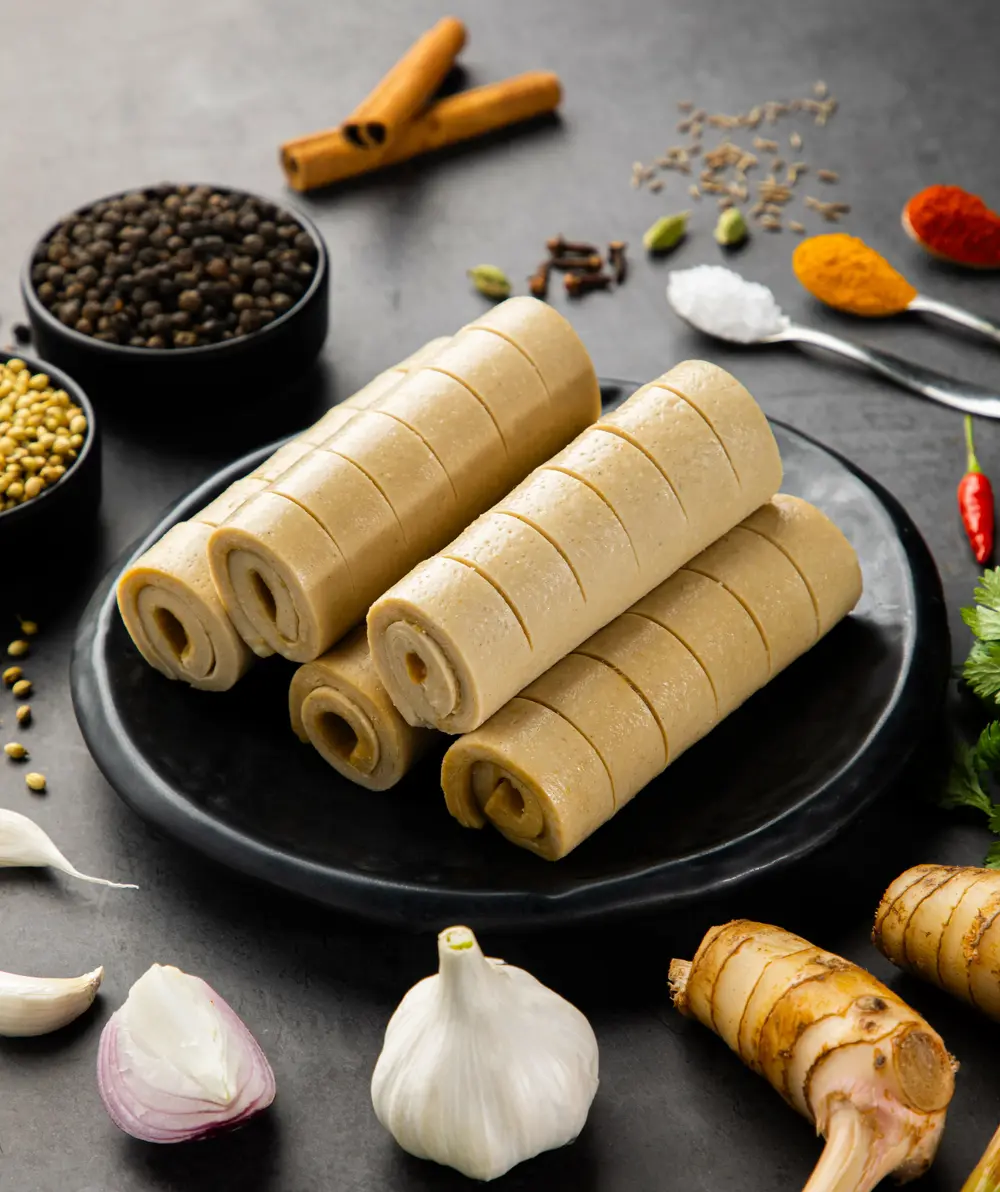
With ours there's no wrapping step at all, so there was never anything for a stick to do. We extrude the protein as a fibrous sheet, and then a line we built ourselves slices it, rolls it up continuously and glues it so the roll holds on its own. The slicing and rolling is patented (#568286), and the continuous rolling and gluing (#597337) only came through this year.
Making a roll out of a sheet is pretty universal across industries, so a lot of the idea came from outside food. Battery cells get wound from long electrode strips, and tissue lines wind paper into rolls off one long sheet. So I tried to visualise what an ideal setup would look like if nobody had ever put a stick in chaap, and worked backwards from that. The first rolls wouldn't hold the shape and the diameter kept changing, and it took a lot of trials before I was happy with one. There was no equipment that could handle the soft protein sheets so we had to make our own custom machines.
All of it runs at Rudrapur, where our QA team has what they call a wooden policy, and wood isn't allowed inside the processing area at all. In September 2025 the USDA's Food Safety and Inspection Service announced a Class I recall of about 58 million pounds of Hillshire Brands corn dogs and sausage on a stick, which may have had pieces of wood embedded in the batter, and according to FSIS the company's own investigation found that "the wooden sticks entered the production process prior to product battering."
What kitchens actually do with chaap
From what I see in kitchens, hardly anyone serves chaap on the stick any more. Mostly it's tikkas, generally around 15 to 20 g, going into a gravy or a roll, so the stick comes out before it goes anywhere near the tandoor. I've also seen kitchens boil frozen stick chaap a second time just to get the stick loose before they can cut it. Ours has nothing to pull out, so it goes straight to the board, and one of the kitchens we supply already buys it from us as tikkas and skips the cutting as well.
Chaap is sold per kg, so the stick counts toward the weight. When we checked, it came to around 7% of the weight, and in canned stick chaap it goes up to about 10% because the chaap is cooked in brine. It's easy to check for yourself too. If chaap is a regular item for you, weigh a few pieces once, then pull the sticks and weigh those on their own.
One buyer asked us for chaap on a stick and told me straight that he couldn't take ours because he'd have no second vendor for it, and one export buyer went the other way and asked for chaap without a stick. But asking for the stick has been very rare. The kitchens growing fastest in chaap haven't had a problem making the switch, and we already supply several of them. We don't make a stick version. What we make is a plain roll, about 30 to 35 mm across, or a tikka cut, frozen, which keeps for 18 months, and the same chaap in retort pouch and can if a kitchen would rather not deal with a freezer at all. I'm not sure chaap on a stick goes away completely in the next few years though, because a roll with a stick poking out of one end is still what a lot of people picture when somebody says chaap.
If you buy chaap for a kitchen, write to us from the soya chaap page and we'll send frozen samples with the spec, then just cut it the way you normally would and see.
Frequently Asked Questions
Why does soya chaap have a stick?+
How is Zippy's soya chaap made without a stick?+
What formats does Zippy soya chaap come in?+
Go Deeper
About the author
Sarthak Singhal is a director of Zippy Edibles, writing from the manufacturing side of the business. Before food, he was a mixed-signal and analog chip-design engineer (Intel, Analog Devices) and studied engineering at Georgia Tech. Connect on LinkedIn →